Blog
PTMT Tap vs Brass Tap: Which Is Better? | Price, Durability & Best Uses


PTMT Tap vs Brass Tap – Complete Buying Guide
Choosing a water tap may look simple until you start comparing materials.
Should you buy a lightweight PTMT tap or choose the traditional strength of a brass tap?
The answer depends on where the tap will be installed, your water conditions, budget, temperature requirements, design preference and expected usage.
PTMT taps are made from an engineered polymer and are popular because they are lightweight, corrosion-resistant and economical. Brass taps, on the other hand, are made from a copper-zinc alloy and are known for their strength, solid construction and premium appearance.
So, there is no universal winner.
For one application, PTMT may be the smarter choice. For another, brass may make more sense.
This guide explains the PTMT tap vs brass tap difference so you can choose the right material for your bathroom, kitchen, utility area or construction project.
What Is a PTMT Tap?
PTMT stands for Polytetra Methylene Terephthalate, an engineered polymer used in plumbing and sanitary fittings.
Unlike conventional metal taps, PTMT taps are manufactured from a high-performance polymer material.
They are commonly chosen for:
- Bathrooms
- Kitchens
- Utility areas
- Balconies
- Gardens
- Washing areas
- Residential projects
- Commercial utility spaces
One of the biggest advantages of PTMT is that the material itself does not rust like conventional ferrous metals.
PTMT taps are also lightweight and generally require less maintenance than metal fittings in environments where corrosion is a concern.
What Is a Brass Tap?
Brass is a metal alloy primarily made from copper and zinc.
Brass has been widely used for plumbing fittings because of its strength, durability and ability to withstand demanding applications.
Brass taps are commonly used in:
- Bathrooms
- Kitchens
- Hotels
- Luxury homes
- Commercial buildings
- Residential construction
- Premium bathroom projects
They are also popular where buyers want a heavier, more substantial metallic fixture and a premium-looking finish.
PTMT Tap vs Brass Tap: Quick Comparison
| Feature | PTMT Tap | Brass Tap |
|---|---|---|
| Material | Engineered polymer | Copper-zinc alloy |
| Weight | Lightweight | Heavier |
| Rust Resistance | Does not rust like metal | Brass itself is corrosion-resistant but surface/coating can vary |
| Corrosion Resistance | Excellent | Good to excellent, depending on alloy and finish |
| Heat Tolerance | Model-dependent | Generally higher |
| Water Pressure | Suitable for specified applications | Generally suitable for higher-pressure applications |
| Maintenance | Low | Low to moderate |
| Appearance | Modern/practical | Premium metallic appearance |
| Price | Generally economical | Generally higher |
| Installation | Easier due to lower weight | Heavier |
| Hard-Water Use | Strong option | Can work well, but finish and maintenance matter |
| Best For | Budget, utility and moisture-prone applications | Premium, heavy-use and hot-water applications |
The exact performance depends on the individual product’s material grade, construction and manufacturer specifications, so the table should be treated as a general buying guide rather than a guarantee for every model.
PTMT vs Brass: Which One Is Better?
The better material depends on your priorities.
Choose PTMT if you want:
- Lower upfront cost
- Lightweight construction
- High corrosion resistance
- Easy maintenance
- Practical everyday performance
- A suitable option for humid or moisture-heavy areas
Choose Brass if you want:
- Heavier construction
- Premium metallic appearance
- Strong mechanical construction
- Better suitability for higher-temperature applications
- Long-term use in demanding installations
In short:
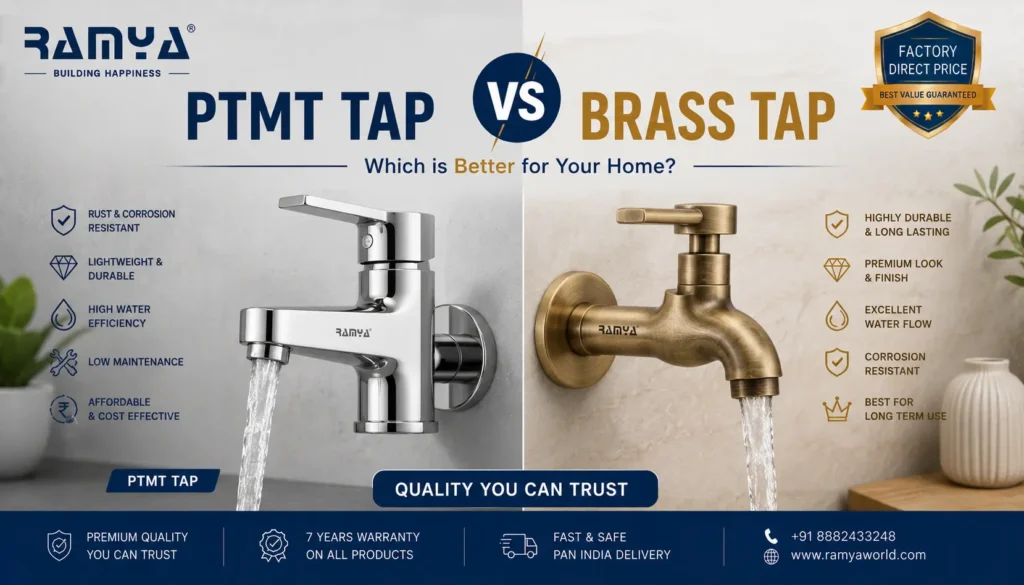
PTMT = practical, lightweight and economical
Brass = strong, premium and versatile
PTMT Tap vs Brass Tap Price
Price is one of the biggest reasons homeowners compare these two materials.
PTMT taps are generally positioned as a more economical alternative to metal taps. Current online PTMT listings show basic models such as pillar taps and angle valves at relatively low prices, although prices vary by manufacturer, model and seller.
Brass taps generally cost more because of:
- Metal material
- Manufacturing process
- Plating/finishing
- Heavier construction
- Internal components
- Premium designs
However, price alone should not determine the purchase.
A ₹500 tap that is unsuitable for your application is not a better deal than a ₹900 tap that fits the installation correctly and performs reliably.
PTMT Tap Benefits
1. Excellent Corrosion Resistance
PTMT does not rust like metal.
This makes it particularly useful in humid environments and areas where water exposure is frequent.
2. Lightweight Construction
A PTMT tap is significantly lighter than a comparable brass fitting.
This can make handling and installation easier.
3. Budget-Friendly
PTMT taps are generally positioned as an economical option for residential and utility applications.
This can be particularly useful when multiple taps are required for:
- New homes
- Apartments
- Rental properties
- Schools
- Utility areas
- Construction projects
4. Suitable for Moisture-Prone Areas
Bathrooms, balconies and outdoor utility points are constantly exposed to moisture.
PTMT’s corrosion resistance makes it a practical choice for these applications.
5. Low Maintenance
PTMT does not require polishing like some decorative metal finishes.
Routine cleaning is still necessary because water minerals and dirt can accumulate on any tap.
Brass Tap Benefits
1. Strong Construction
Brass provides a solid and durable body.
This is one reason it remains popular in bathroom and kitchen fittings.
2. Premium Appearance
Chrome-plated and other finished brass taps can provide a polished, premium appearance.
This makes brass particularly attractive for:
- Luxury bathrooms
- Designer kitchens
- Hotels
- Premium apartments
- High-end villas
3. Good Heat Tolerance
Brass generally handles hot-water applications better than many polymer-based alternatives.
For hot-water systems, always check the manufacturer’s specified temperature limits before installation.
4. Suitable for Demanding Applications
Where strength and pressure handling are important, brass can be a strong choice.
That is especially relevant for commercial and premium plumbing installations.
PTMT Tap vs Brass Tap for Hard Water
Hard water is a major concern in many Indian homes.
Minerals in hard water can leave deposits on: Flipkart
- Faucet bodies
- Aerators
- Handles
- Spouts
- Connections
PTMT has an important advantage here: the polymer itself does not corrode like metal.
Some manufacturers specifically position PTMT taps for hard-water environments because of their corrosion and scale resistance.
However, there is an important distinction:
Rust resistance does not mean mineral deposits can never form.
Hard-water households should still clean taps and aerators regularly.
Brass taps can also perform well in hard-water environments, but the actual alloy, plating, coating and water chemistry matter.
PTMT Tap vs Brass Tap for Bathroom
For bathrooms, both materials can be appropriate.
PTMT Bathroom Tap
A PTMT tap can be a good choice for:
- Guest bathrooms
- Utility bathrooms
- Rental homes
- Budget renovations
- High-humidity areas
- Outdoor bathroom points
Its lightweight, corrosion-resistant construction makes it practical for everyday use.
Brass Bathroom Tap
Brass is especially attractive for:
- Master bathrooms
- Premium bathrooms
- Luxury villas
- Hotels
- Designer interiors
The solid feel and metallic finish can complement premium bathroom accessories and sanitaryware.
PTMT Tap vs Brass Tap for Kitchen
The kitchen presents a different set of requirements.
Kitchen taps are frequently used for:
- Washing vegetables
- Cleaning utensils
- Filling vessels
- Washing large cookware
- General water supply
For a standard cold-water kitchen point, PTMT can be a practical option.
For premium kitchens, heavy-duty installations or hot-and-cold systems, brass may be preferable depending on the faucet design and manufacturer’s specifications.
PTMT Bib Cock vs Brass Bib Cock
A bib cock is commonly installed on a wall water outlet.
PTMT Bib Cock
Advantages:
- Lightweight
- Corrosion-resistant
- Economical
- Easy to handle
- Suitable for many standard applications
Brass Bib Cock
Advantages:
- Strong metallic construction
- Premium appearance
- Suitable for demanding applications
- Good compatibility with conventional plumbing systems
Choose based on application rather than simply choosing the heavier material.
PTMT Pillar Cock vs Brass Pillar Cock
A pillar cock is commonly used with wash basins.
For a budget washbasin installation, PTMT can provide a practical and economical option.
For premium bathrooms where appearance and solid construction are priorities, brass is often the preferred choice.
The basin design and mounting arrangement should also be considered before purchase.
PTMT Tap vs Brass Tap for Outdoor Use
Outdoor installations are exposed to:
- Rain
- Humidity
- Dust
- Temperature changes
- Hard water
- Frequent water splashes
PTMT can be particularly useful where corrosion resistance is a major concern.
Suitable applications may include:
- Garden taps
- Balcony taps
- Utility areas
- Outdoor washing points
- Terrace water points
For commercial or high-pressure outdoor applications, verify the product’s pressure and temperature specifications before installation.
PTMT vs Brass for Hot Water
This is one area where brass generally has an advantage.
Brass is naturally suitable for many hot-water plumbing applications.
PTMT performance is model-dependent.
Some PTMT products have defined hot-water temperature limits, so the manufacturer’s specification must be checked before connecting a PTMT tap to a hot-water line. For example, current manufacturer documentation for some PTMT ranges specifies temperature limits rather than treating all PTMT products as universally hot-water compatible.
Simple rule:
For hot-water applications, don’t guess—check the product’s rated temperature range.
PTMT vs Brass for Water Pressure
Water pressure is another factor that should not be oversimplified.
Brass is a strong metal and is commonly used in plumbing systems where robust mechanical performance is required.
PTMT taps can also be suitable for normal residential water pressure when manufactured and rated appropriately.
Before buying, check:
- Recommended pressure
- Inlet connection
- Valve construction
- Manufacturer specifications
- Installation requirements
For high-pressure systems, choose a product specifically rated for the application.
Which Tap Is More Durable?
This depends on what you mean by “durable.”
PTMT Durability
PTMT offers:
- Corrosion resistance
- Lightweight construction
- Resistance to moisture-related rust
- Low maintenance
Brass Durability
Brass offers:
- Strong mechanical construction
- Good heat tolerance
- Long service potential
- Premium-quality feel
So the question isn’t simply:
“Which lasts longer?”
The better question is:
“Which material is more suitable for my environment?”
Which Tap Is Better for a New House?
For a new house, you don’t necessarily have to use one material everywhere.
A smart approach is to choose according to the application.
Example
Master Bathroom: Brass
Guest Bathroom: PTMT or brass
Kitchen: Brass or suitable PTMT
Garden: PTMT
Balcony: PTMT
Utility Area: PTMT
Hot-Water Connection: Brass or a specifically temperature-rated PTMT product
This mixed-material strategy can balance performance, appearance and project cost.
Which Tap Is Better for Builders?
Builders often need to balance:
- Purchase cost
- Quantity
- Availability
- Installation speed
- Maintenance
- Appearance
- Product consistency
PTMT can be attractive for projects where economical and corrosion-resistant fittings are required across many water points.
Brass can be better suited to premium specifications and areas where a higher-end finish is expected.
For large projects, compare equivalent models and confirm bulk availability before finalizing the BOQ.
PTMT vs Brass: Maintenance Comparison
| Maintenance Factor | PTMT | Brass |
|---|---|---|
| Rust cleaning | Minimal concern | Depends on finish/environment |
| Polishing | Usually unnecessary | May be useful for decorative finishes |
| Hard-water cleaning | Required | Required |
| Aerator cleaning | Required | Required |
| Surface wiping | Recommended | Recommended |
| Chemical exposure | Follow manufacturer guidance | Follow manufacturer guidance |
Neither material should be treated as completely maintenance-free.
Regular cleaning improves appearance and helps identify leaks or component wear early.
How to Choose the Right Tap Material
Before buying, ask these seven questions:
1. Where will the tap be installed?
Bathroom, kitchen, garden or utility?
2. Is hot water involved?
If yes, check temperature compatibility.
3. Is your water hard?
If yes, corrosion and scale resistance become more important.
4. What is your budget?
PTMT can be attractive for cost-sensitive projects.
5. Do you want a premium metallic appearance?
If yes, brass may be more suitable.
6. What is the water pressure?
Check product specifications.
7. Is replacement easy?
Choose a commonly available model with suitable connections and replacement components.
Common Mistakes When Buying PTMT or Brass Taps
Mistake 1: Choosing by Weight
A heavier tap is not automatically better.
Mistake 2: Choosing by Appearance
A shiny finish does not tell you everything about the underlying material.
Mistake 3: Ignoring Water Temperature
Not every tap is designed for hot water.
Mistake 4: Ignoring Connections
Check the inlet size and installation configuration.
Mistake 5: Buying Without Checking Specifications
Material, pressure and temperature ratings matter.
Mistake 6: Assuming PTMT Means Low Quality
PTMT is an engineered polymer category; quality depends on the material, manufacturing process and product design.
Mistake 7: Assuming Brass Never Corrodes
Brass is corrosion-resistant, but surface finishes and water chemistry can still affect its appearance and condition.
PTMT Tap vs Brass Tap – Final Verdict
There is no single winner.
PTMT is the better choice when you prioritize:
- Affordable pricing
- Corrosion resistance
- Lightweight construction
- Low maintenance
- Everyday residential use
- Utility and outdoor applications
Brass is the better choice when you prioritize:
- Strength
- Premium appearance
- Heavy-duty construction
- Higher-temperature applications
- Premium bathrooms and kitchens
- Long-term investment in higher-end fittings
The smartest approach?
Choose the material according to the application—not simply according to price or brand.
For many Indian homes, a combination of PTMT and brass fittings can provide the best balance of budget, durability, aesthetics and performance.
Frequently Asked Questions
Is PTMT better than brass?
Not universally. PTMT is often better for economical, corrosion-resistant and lightweight applications, while brass is better suited to premium, heavy-duty and many hot-water applications.
Which tap is best for hard water?
PTMT can be a strong option because the material does not rust and is resistant to corrosion. Brass can also work well, depending on its alloy, finish and the water conditions.
Is PTMT tap durable?
Quality PTMT taps are designed for regular plumbing use and can provide long service when properly installed and maintained.
Are brass taps better for bathrooms?
Brass can be an excellent choice for premium bathrooms because of its strength, metallic appearance and suitability for demanding applications.
Are PTMT taps cheaper than brass taps?
Generally, PTMT taps are positioned as a more economical alternative, although actual prices vary by model, manufacturer and seller.
Can PTMT taps be used for hot water?
Only when the specific product is rated for the required temperature. Always check the manufacturer’s temperature specification before installation.
Which is better for outdoor use, PTMT or brass?
PTMT can be particularly practical outdoors because of its corrosion resistance and lightweight construction.
Which tap is better for a kitchen?
Both can work. PTMT can suit standard cold-water applications and budget installations, while brass is often preferable for premium kitchens and demanding or hot-water applications.
Does PTMT rust?
PTMT itself does not rust like metal because it is an engineered polymer rather than a ferrous metal.
Does brass rust?
Brass does not rust in the same way iron or steel does, but it can undergo corrosion or surface deterioration depending on its composition, finish and environment.
Which tap is best for a new house?
There is no universal answer. Use brass where premium appearance, strength or hot-water compatibility matters, and PTMT where corrosion resistance, low weight and economical pricing are priorities.
FAQ Schema Questions
Use FAQ structured data only for questions that are actually visible on the page.
Recommended questions:
- Is PTMT better than brass?
- Which tap is best for hard water?
- Is PTMT tap durable?
- Are brass taps better for bathrooms?
- Are PTMT taps cheaper than brass taps?
- Can PTMT taps be used for hot water?
- Which is better for outdoor use, PTMT or brass?
- Which tap is better for a kitchen?
- Does PTMT rust?
- Does brass rust?
- Which tap is best for a new house?